
THE BOOK IS THE PROOF. THE SITE SHOULD SELL IT.
Author website design and development for writers with a book to move, a list to build and a next one coming. Bespoke, sub-second, live in two weeks.
- A #1 bestselling author, rebuilt in 7 days
- 100 PageSpeed on that build
- Your list, not a retailer's
- You edit it yourself
THE RETAILER KEEPS THE READER. YOU KEEP NOTHING.
Somebody finishes your book, loves it, and looks you up. What happens next decides whether you have a career or a title. Amazon has their email address and their card details and will not be sharing either, your publisher's page comes down when the campaign ends, and the platform you post on owns the audience it rented you. The site is the one place a reader can become yours.
The general case for a build, the speed receipts and every site we have shipped are on website development. If you speak and consult more than you publish, personal brand websites is the page for that.
AN AUTHOR SITE, LIVE.
A #1 bestselling author, rebuilt end to end and shipped in seven days. Open it, then read what changed.
- jayyanginspires.com
 Jay YangAuthor, operator, investorRead the case study
WHAT ACTUALLY CHANGED.
A #1 bestselling author with 100,000+ followers, behind a website that hid every bit of it. Rebuilt end to end, brief to live in seven days.
7 days
Brief to live, domain migration included
- 01
A headline that fit anyone
“A simple and proven way to accelerate your career.” Template copy that could sit on a thousand other sites. Nothing said who Jay was, or why 100,000 people already follow him.
- 02
The bestseller, buried
His #1 book shared a row with two empty “Coming soon” boxes. The one asset people arrived for was framed as a work in progress.
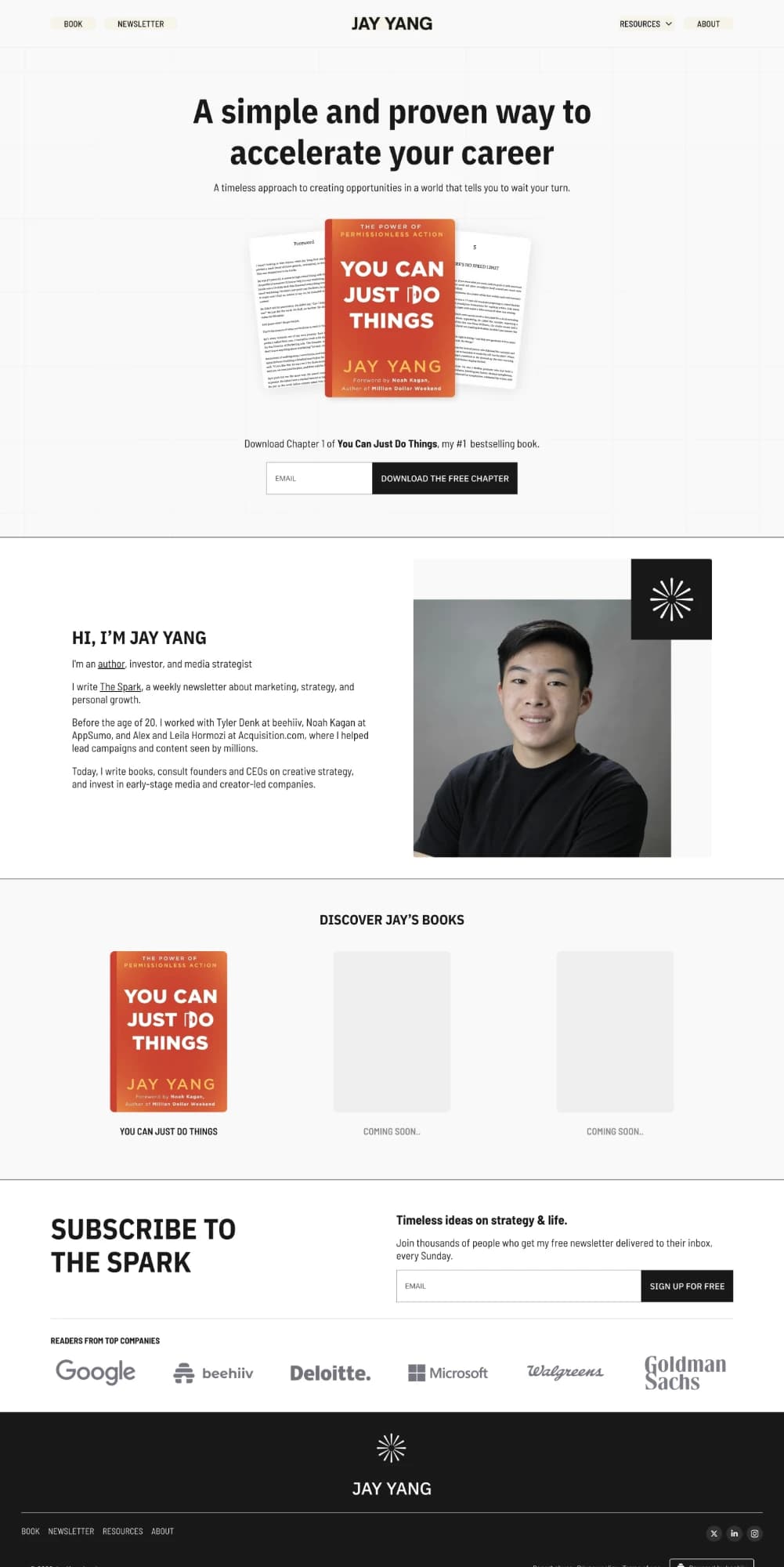
Stock template copy over a template layout, split thin across four near-empty pages.
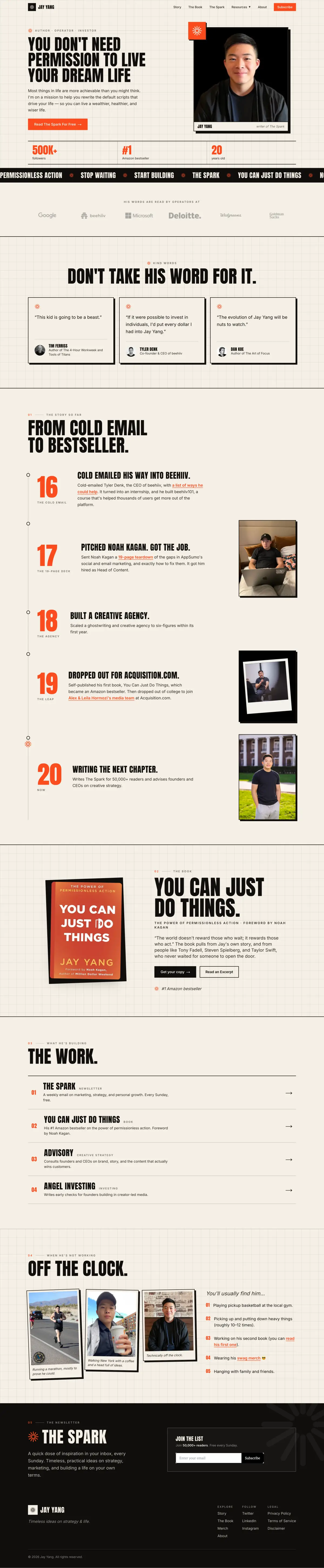
One page that carries the book, the newsletter, the fund and the story, in his voice.
100
PageSpeed performance on the live site
7 days
Brief to live, domain and all
100K+
Followers the site finally reflects
TODAY, AND AFTER.
| Today | After |
|---|---|
| The book is below the fold, under a biography | Cover, one line, buy button, above the fold |
| One buy link, to one retailer, in one country | Every retailer, and the reader picks |
| No way to leave an email address | One offer, one field, on every page |
| A journalist has to email you for a headshot | A press kit they can use without asking |
| Speaking enquiries arrive with no detail | A page that answers the first four questions |
| The next book means a developer | You add it in ten minutes |
AND WHAT HE SAID AFTERWARDS.
- ★★★★★
“Working with Nitesh was awesome. He took complete ownership of the website rebuild and handled everything from the setup to the transfer. He was super quick with making changes and was constantly predicting the next things we would need and solving them. It's rare for me to write a testimonial for anyone, but Nitesh completely deserves it. Can vouch!”

Jay Yang
Author of You Can Just Do Things
WHAT IT COSTS.
Starting prices
One pager + CMS
One book, one list, one next step.
From$1,200
- The book, the buy links and the sign-up in one scroll
- A CMS for the parts that change
- Same speed and SEO work as the full build
Full site + CMS
A backlist, a newsletter, speaking and press.
From$6,000
- A page per book, and a press kit that stands on its own
- A writing or newsletter archive you add to yourself
- Schema, sitemap and every old URL mapped
A floor, not a quote. You get a fixed scope and a fixed price in writing before we write a line of code. Priced in the currency you pay in, never converted at live rates.
- 50% to start, 50% at launch
- No hourly meter, no surprise invoices
- If the budget does not fit, we say so on the call
WHAT WRITERS ASK BEFORE THEY BUILD ONE.
Amazon sells this book. A website sells you, which is what sells the next one. The retailer keeps the reader's email address and their card details and gives you a sales rank, so every reader you earn through them is a reader you have to buy again on launch day. The people who leave an email address on your own site are the only audience you own outright, and for most authors that list is worth more than any single campaign.
Five things. The book, with the cover, one sentence on what it does for the reader, and a buy button, all above the fold. A way to leave an email address, with one clear reason to. A page about you written for a reader rather than a bio in the third person. A press kit. And, if you speak, a page that answers what you talk about, to whom and how to book you. Everything else is optional and most author sites have the optional parts and not these.
Before, and earlier than feels necessary. The site is where pre-launch attention goes to be captured, and a list built in the three months before publication is what makes launch week work. If the book is already out, build it now anyway: the reader who finished it last night is looking for you tonight. A site that goes live a fortnight after launch missed the only week the whole industry is pointed at you.
Almost never. One site with a page per book, and the newest one on the front, keeps every bit of authority and every link you have ever earned in one place. A dedicated domain per title splits that and leaves you with a site to maintain for a book that stopped selling. The exception is a title with a genuinely separate audience under a pen name, where mixing the two would confuse both.
Give the reader the choice, and put their likely one first. A single Amazon link loses everybody outside its home country, everybody who reads on Kobo, everybody who wants the audiobook and everybody who would rather order through a bookshop. A short list of retailers converts better than a single link, and if you sell a signed copy or a direct edition yourself, that goes at the top, because it is the only version where you keep the margin and the customer.
Ask once, in the same place on every page, and offer something specific. A pop-up that arrives four seconds after somebody lands is why most readers now reflexively close them. What works is a fixed sign-up block with a real reason attached: the first chapter, a worked example from the book, the notes you cut. One offer, one field, and no second page asking their company size.
Everything a producer or a journalist would otherwise have to email you for, downloadable, at the sizes they need: a short and a long biography, two headshots, the cover at print resolution, the blurb, your topics, previous appearances and one contact address. It sounds administrative and it is the highest-converting page on many author sites, because the person reading it has already decided to feature you and is looking for a reason not to have to wait.
The structure is the same and the emphasis moves. The series and the reading order matter more than a press kit, the list is usually built on the promise of the next release rather than a lead magnet, and the design carries genre signals that tell a browsing reader in one second whether this is for them. What does not change is that the retailer keeps your reader unless your own site gets there first.
It is not, and it is worth understanding why rather than resenting them. That page exists to sell one title during one campaign, it lives on their domain, and it will be quietly retired when the campaign is. You cannot build a list on it, you do not control it, and it does not follow you to your next publisher. Have both. Theirs is a marketing asset for the book and yours is the asset for your career.
Send us your site and the book you want it to move.
We will tell you straight whether a rebuild is the right spend before the next launch, and say so if it is not.